


Applies to: BI 4.3, BI 2025, BI 2027 · Reading time: 8 min
In short. BI 4.3 is the last version of the “4.x + Support Packages” model; BI 2025 is the first of the new model (a major release every two years, regular patches); BI 2027 is the next one, announced and in preparation. The platform and the core of Web Intelligence are the same; what changes is report interactivity (new elements), sharing (WIDX export), the technical base (Java, retired components) and the maintenance rhythm. The choice is not about features but about your upgrade calendar.
Comparison table
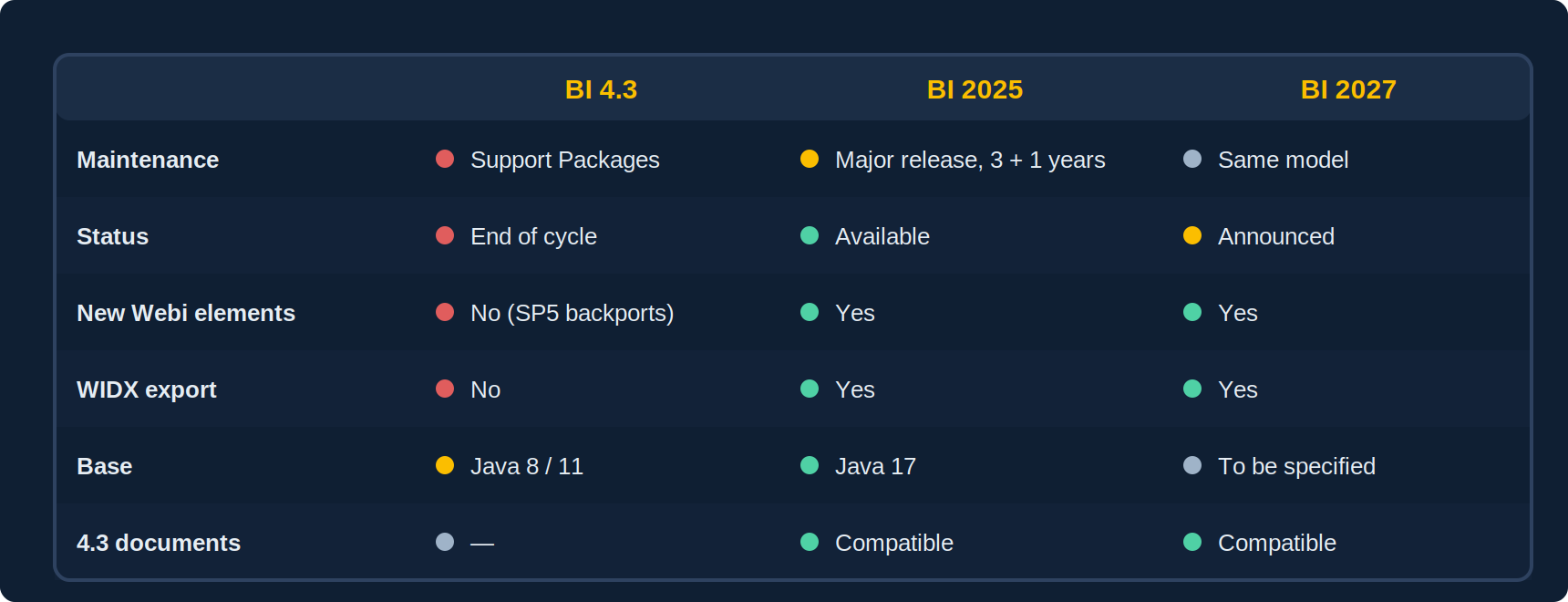
| BI 4.3 | BI 2025 | BI 2027 | |
|---|---|---|---|
| Maintenance model | Support Packages (SP5 is the last) | Major release, 3 years of maintenance + 1 year of security, regular patches | Same model |
| Status | End of cycle, security fixes | Available, in mainstream maintenance | Announced, upcoming |
| Webi elements | Classic elements; some BI 2025 improvements backported in SP5 | New interactive (UI5) elements alongside the classic ones | Expected continuity of the new elements |
| WIDX export | No | Yes, for documents built with the new elements | Yes |
| Technical base | Java 8 / 11 depending on SP | Java 17, updated platforms and data sources | To be specified by SAP |
| Retired components | Dashboards (Xcelsius), Explorer, Universe Design Tool already gone | UDT, UNV and conversion, multi-source, MDX OLAP, QaaWS; Rich Client not installed by default | Progressive removals |
| Document compatibility | — | 4.3 documents open as they are | Same, except retired components |
BI 4.3: the end of the Support Package model
BI 4.3 brought Data mode (data preparation inside Webi), a modernised interface and a long series of improvements SP after SP. SP5 is the last: it received some BI 2025 enhancements as backports, but not the new interactive elements nor the WIDX export. A 4.3 estate is healthy, but it sits on a branch that only receives security fixes. The issue is not whether to “stay on 4.3”; it is choosing the target version and the date. For what end of maintenance actually covers, and how to judge your own urgency, see our end-of-maintenance article.
BI 2025: what changes in practice
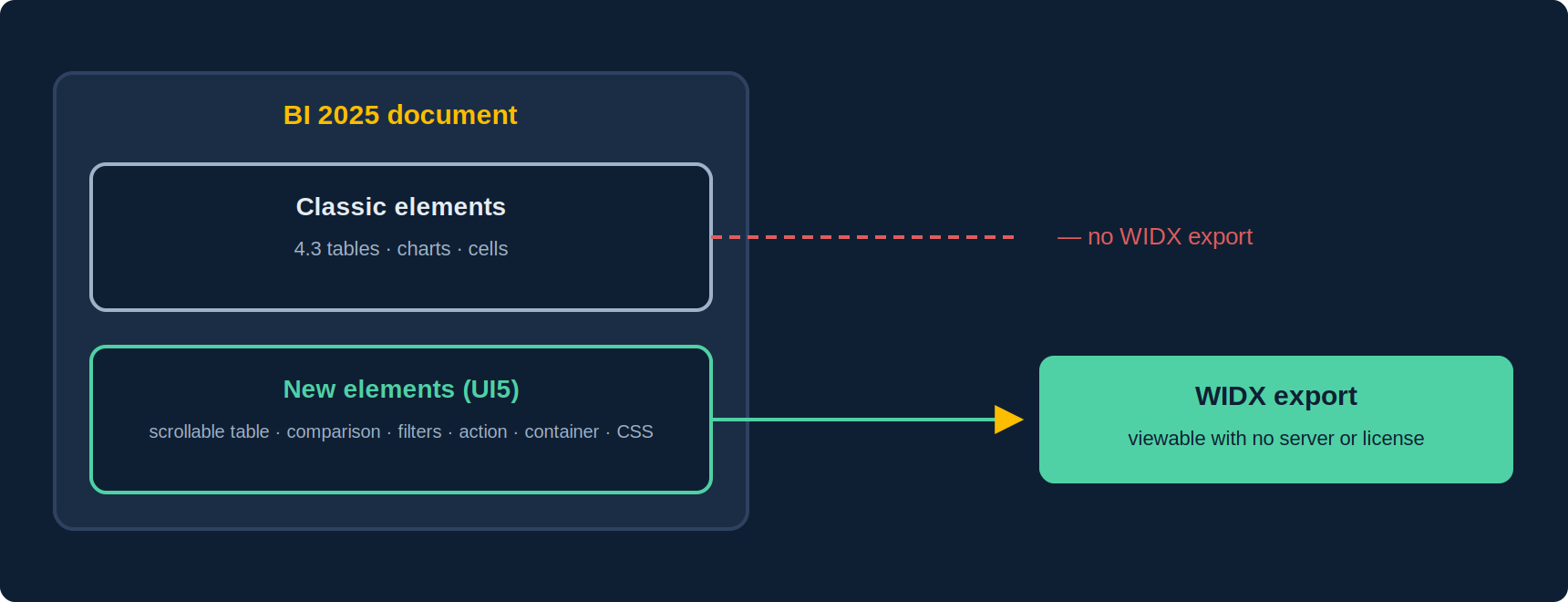
- New report elements: scrollable table, comparison, filters, cells, rich text, action, container, CSS editor. They bring interactivity (in-page filters, navigation) and finer formatting. Classic elements remain available; an existing document does not need to be rewritten.
- WIDX export: an interactive format viewable with no BO server and no license, generated from Webi or by scheduling. It is only compatible with the new elements, free cells and sections that are not dynamically filtered: a classic report must be rebuilt to benefit from it. Limits of this first release: one report and its first page only, viewing on Windows with Chrome or Edge, static data (no refresh, interactive sort or drill), and no email or BI inbox delivery when scheduled. See our WIDX article.
- Data mode: strengthened preparation and transformation, continuing from 4.3.
- Base: Java 17, new platforms and data sources in the PAM, Rich Client to be installed separately.
- Removals: Universe Design Tool, UNV universes and their conversion (to be done on 4.3 before upgrading), multi-source universes, federated tables, BI Sets, MDX OLAP connections (replaced by BICS), QaaWS/DaaWS. Full list in SAP KBA 3560025.
- Maintenance: regular patches instead of SPs, which changes how updates are organised (more frequent, smaller).
BI 2027: what we know
SAP has confirmed BI 2027 as the next major release, in the same maintenance model, with BI 2029 behind it. The detailed functional content is not yet public; the expected continuity is the extension of the new Webi elements and the WIDX export, further Data mode work, and more removals of legacy components. For an upgrade project, BI 2027 is a reasonable choice if your calendar is more than eighteen months out; otherwise, BI 2025 is available, proven and under mainstream maintenance.
Which choice for your situation
| Situation | Recommendation |
|---|---|
| On 4.2 or earlier | Target BI 2025 in three steps: move to 4.3, test and validate, then move to BI 2025 (see the box below) |
| On 4.3, upgrade possible within the year | BI 2025: available, stable, and you enter the new cycle |
| On 4.3, no upgrade possible for 18 months | Move to 4.3 SP5 now, target BI 2027 |
| Strong need for interactivity and off-platform sharing | BI 2025 for the new elements, complemented by extensions for existing reports |
| Very large, legacy report estate | Audit first (retired components, UNV), then BI 2025; do not plan a mass rewrite to the new elements |
Expert view
“Target” and “path” are two different questions. And nothing says you have to stop at BI 2025.
The table above gives a target, not an itinerary. Jumping straight from 4.2 to BI 2025 is technically possible, but it is not the recommended route. The advised path runs in three steps: move to 4.3, test and validate the estate on that version, then move to BI 2025.
That middle step is the whole point of the arrangement, and it is the one people treat as a formality. It is on 4.3 that you confirm the repository came across, that universes answer, that security and schedules followed — on a version that is still maintained, where the UNV conversion tool still exists and where support will answer if something breaks. Skip it, and you pile the repository migration, the universe conversion and the stack change into a single switch: if the result is wrong, nothing tells you which of the three is to blame.
The practical consequence is a workload, not a technical difficulty: a 4.2 estate aiming at BI 2025 plans for two upgrades and an acceptance phase between them, even though nobody will stay on that 4.3 for long.
Which opens a second option, rarely discussed and yet serious: settle on 4.3 SP5 and aim straight for BI 2027. The point is not to save time, it is to spend your effort in the right place. Converting UNV universes to UNX is the real work of this transition, and it is exactly the work you want to do without schedule pressure, while the conversion tool is still there — it is removed in BI 2025. Better to do it calmly on 4.3 than inside the window of a platform switch.
The second argument is technical. BI 2025 sits on a front-end stack — SAP UI5 among others — that is set to give way in BI 2027. An organisation upgrading to BI 2025 today will therefore absorb two stack changes in two years. One that stays on 4.3 SP5 and skips a generation absorbs only one, at the cost of a frozen estate in the meantime and a branch receiving security fixes only.
So the decision comes down to three questions, in this order: how long your 4.3 stays supported given your compliance requirements, how many UNV universes you actually have, and whether you have the resources for two platform projects in two years rather than one. There is no universal right answer — but there is a wrong way to decide, which is to compare features only.
Frequently asked questions
Do my 4.3 reports need to be rewritten for BI 2025?
No. They open and work as they are. Only reports based on a UNV, a multi-source universe or an MDX connection need a change of source before they can be refreshed.
Can I export a 4.3 report opened in BI 2025 to WIDX?
No, unless it is rebuilt with the new elements. WIDX is a format for the new elements.
Can I go from 4.2 to BI 2025 in a single operation?
Technically yes, but it is not the recommended route. The advised path runs in three steps: move to 4.3, test and validate the estate on that version, then move to BI 2025. That does not change the target, it changes the workload — two upgrades and an acceptance phase between them, instead of a single switch. Check the path that applies to your precise starting point (4.2 SPxx) in SAP’s upgrade matrix before committing to a schedule.
Is 4.3 SP5 enough to wait for BI 2027?
Technically yes, but you stay on a security-fixes-only branch. Check the dates in the PAM and your exposure (OS, Java, browsers). It is a defensible scenario if you use the time to convert your UNV universes to UNX while the conversion tool is still available.
Should I wait for BI 2027 to avoid an intermediate upgrade?
In the new model each version is maintained for three years: going BI 2025 then BI 2027 is not mandatory. BI 2025 → BI 2029 is a possible path.
Sources and references
- Christian Ah-Soon (SAP), “SAP BI 2025: What’s New In Web Intelligence and Semantic Layer”, SAP Community, March 2025
- SAP Community — “Welcome to SAP BusinessObjects BI 2025”
- SAP Community — “SAP BusinessObjects BI Future is clarified”
- SAP KBA 3540544 — BI 2025 Maintenance Strategy & Schedule
- SAP KBA 3560025 — components and features removed in BI 2025 (SAP for Me access)
- Need4Viz — “SAP BI 2025: New Features, Limitations and N4V Solutions”
- Decinova — “SAP BO BI 2025: what’s changing, what’s retiring” (third-party source for the Java 17 base)
👉 Discover Need4Viz and what we really bring to SAP Web Intelligence
Need4Viz extends SAP Web Intelligence with advanced dataviz, interactivity, automation and AI capabilities to transform your reports into real decision-making tools.
Discover Need4Viz