


Updated October 14, 2026 · Versions covered: BI 4.3, BI 2025, BI 2027 and later · Reading time: 8 min
SAP Data & Analytics, Statement of Direction for SAP BusinessObjects BI and SAP Data Services · October 2026 · 11 pages · public.
Read the original document on sap.com →
Page references (SoD, p. X) in this article point to this document.
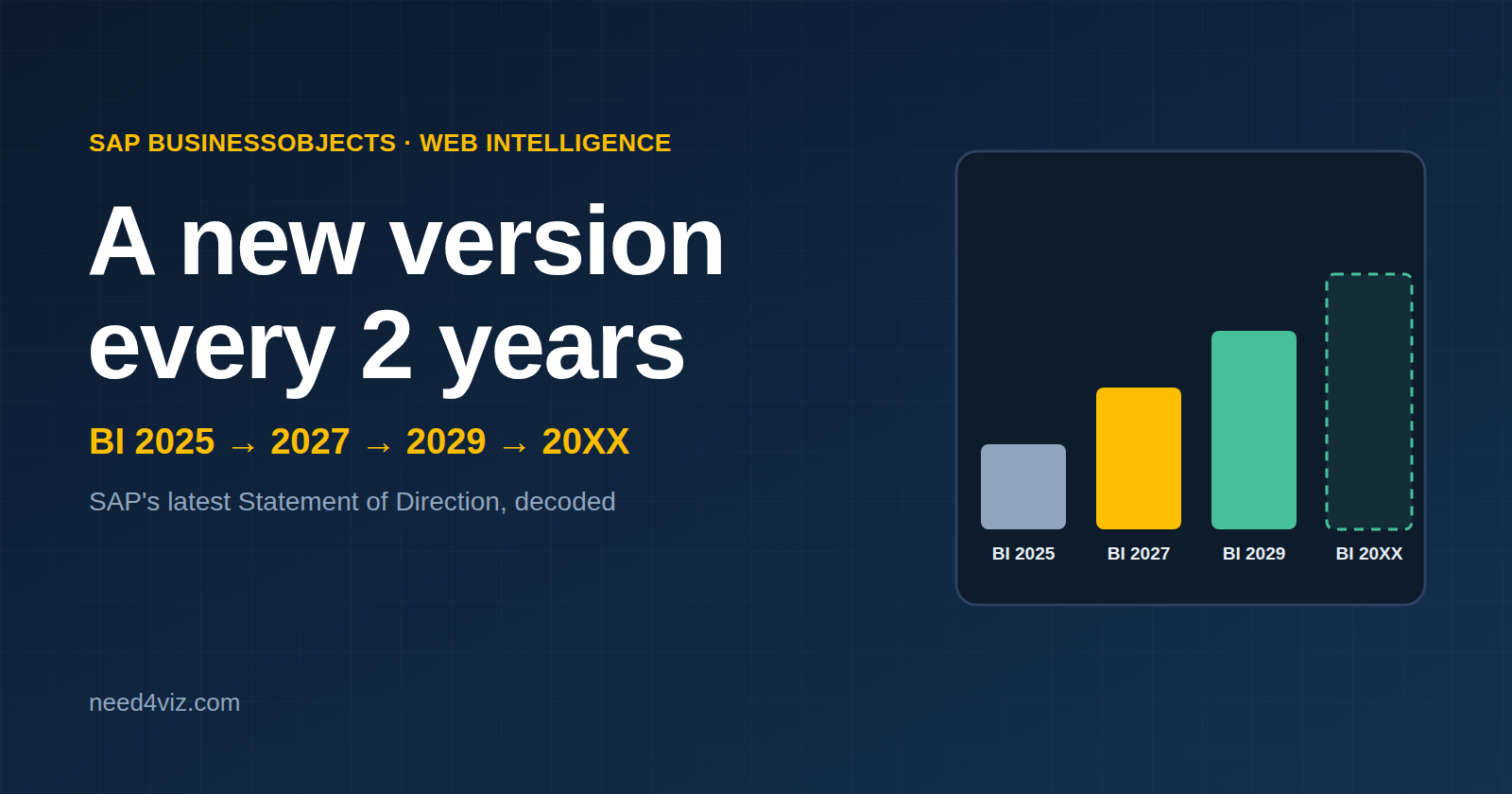
In short. SAP’s October 2026 Statement of Direction reads less like an announcement than a change of regime: SAP sets a BI 20XX release rhythm of one platform version every two years, with Web Intelligence as the central tool. For organizations running BusinessObjects, the question is no longer “does BO continue?” but “which tools and which infrastructure should we keep to follow the rhythm?”
At a glance
- No disruption announced. SAP speaks of “coexistence, not disruption”: BI 2025 is available, BI 2027 is planned, and BI 2029 already appears on the maintenance roadmap.
- A new rhythm. One platform version every two years, each with three years of Mainstream Maintenance, instead of the annual support packs of 18 months. (SoD, p. 7)
- A tighter portfolio. Lumira Designer will be discontinued after the 2029 release; seven other components (.unv universes, Crystal Reports for Enterprise, Lumira Discovery, Analysis edition for OLAP, Live Office, Mobile, multi-source universes) are no longer delivered after BI 4.3; most were already removed in BI 2025. (SoD, p. 5 and 8)
- Web Intelligence becomes the pivot. BI 2027 is expected to bring two report types in a unified document model, including responsive dashboards with offline access. (SoD, p. 4)
- Two paths forward. BusinessObjects (on-premise or private cloud) for governed reporting; SAP Business Data Cloud recommended for new cloud-native, planning and AI use cases.
The central message: coexistence rather than forced migration
SAP positions BusinessObjects BI as its enterprise reporting platform for governed, mission-critical reporting at scale. SAP Business Data Cloud (BDC) is the recommended foundation for new cloud-native use cases, planning and AI.
The document repeats this in several ways: customers “do not need to move all workloads to the cloud immediately”, and modernization is “incremental and based on functional fit”. (SoD, p. 3 and 9) Five priorities structure the investments in BO: reduce total cost of ownership, improve support quality, secure the platform’s future, increase productivity for power users, and reach more business users. (SoD, p. 4)
What to read between the lines: BI 20XX, a cycle that no longer needs to be announced
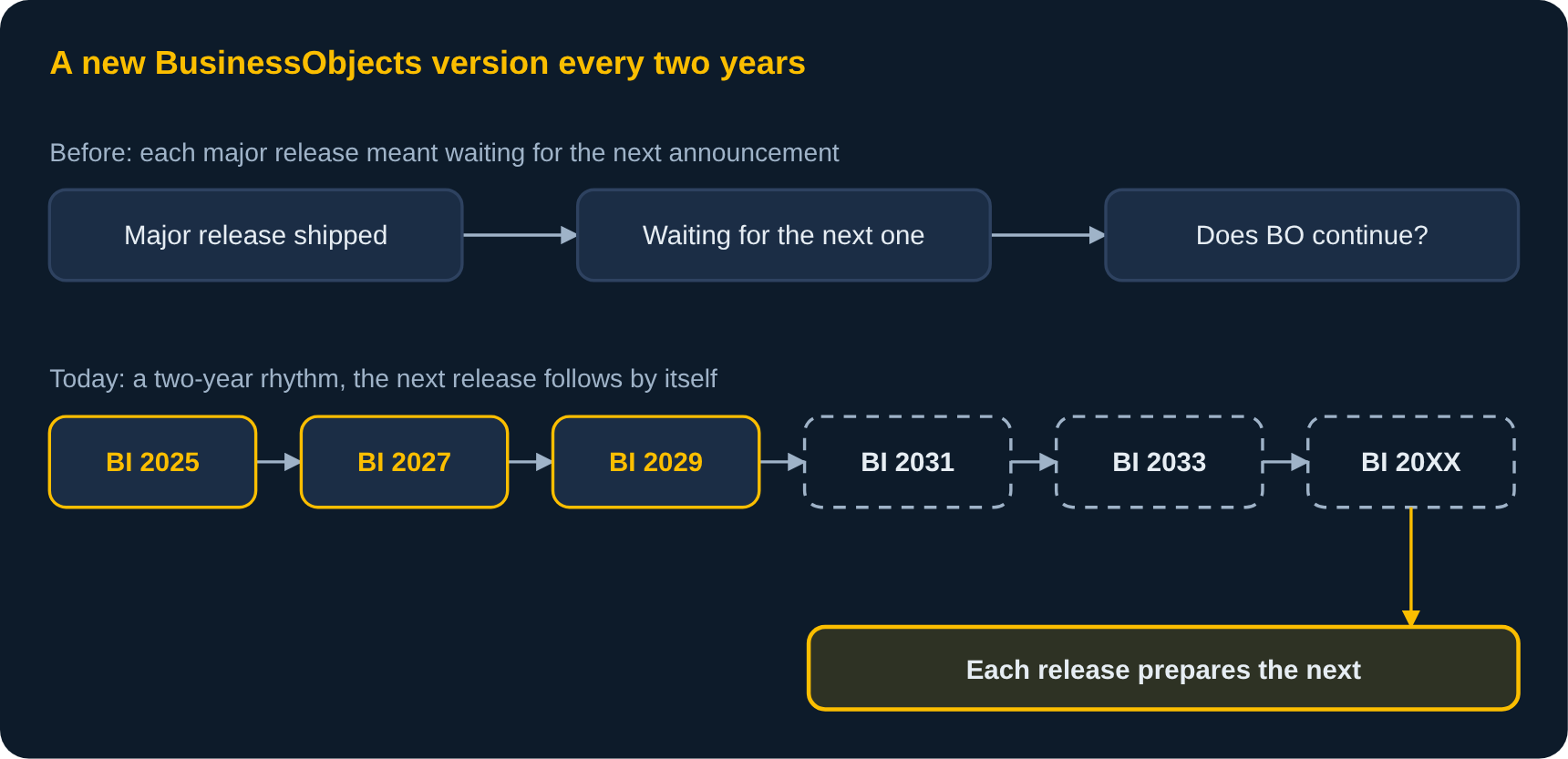
The most important change is the one the document does not put in a headline. With a platform version every two years, SAP no longer thinks in terms of a “latest version”. Until now, each major release raised the question of the next one, and companies waited for an announcement to learn whether BO would continue or be decommissioned.
The maintenance roadmap answers differently: BI 2025, BI 2027 and BI 2029 follow one another, and SAP’s chart leaves the rest open. The logic is that of a BI 20XX: after 2029, the next version simply follows, two years later. There is no need to wait for SAP to “announce” a BI 2031, then a BI 2033, then a BI 2035 to know that BO continues: these versions are the natural continuation of the rhythm, not decisions still to come. Continuation becomes BusinessObjects’ default mode.
What changes in practice
1. A more readable release cycle
Since BI 2025, SAP delivers one platform version every two years, each covered by three years of Mainstream Maintenance. This replaces the annual support packs, which offered 18 months of support per version. Between two versions, fixes, platform certifications and critical updates remain planned.
SAP’s maintenance chart shows the following pattern, which we read as follows: for each version, a Mainstream Maintenance phase, then about one year of security fixes, then Customer Specific Maintenance (CSM), where support services continue but software updates stop. BI 2027 then BI 2029 follow this model, the one BI 2025 inaugurated (three years of maintenance, then one year of security fixes), detailed in our BI 4.3 / BI 2025 / BI 2027 comparison article. Data Services and Information Steward follow the same rhythm, about one quarter later. (SoD, p. 7)
SAP also announces an Early Adopter Care program for BI 2027: one or two quarters after availability, a selected group of customers with an active upgrade project works directly with SAP development teams, and their incidents are handled with priority in the normal fix cycle. The document gives no availability date for BI 2027. (SoD, p. 5)
2. A tighter technical platform
- Java application server: in BI 2025, only IBM WebSphere Liberty 25 is supported as an external server; from BI 2027, SAP relies only on the embedded Tomcat. (SoD, p. 4) With BI 2025, the end of NetWeaver support already required moving to Tomcat.
- Authentication: SAML is no longer supported beyond BI 2025 (deprecated in 2025, fully removed in 2027). Only OAuth 2.0 and OpenID Connect remain. (SoD, p. 4)
- Operating systems: AIX and Solaris are no longer supported after version 4.3, and are therefore already absent from BI 2025; Windows and Linux are the preferred systems. Crystal Reports 202x services are supported only on Windows, starting with 4.3 SP2: Crystal Reports on Linux is thus already removed in BI 2025. (SoD, p. 8)
- BI Launch Pad: SAP keeps modernizing it and makes it the entry point for business users.
3. A rationalized tool portfolio
SAP concentrates its investments on the most used tools. The table below reproduces SAP’s list of components that will no longer be delivered or supported after BI 4.3, with the alternatives SAP cites. (SoD, p. 8)
| Component | Last version | End of Mainstream Maintenance | Alternative cited by SAP |
|---|---|---|---|
| Universe Design Tool and .unv universes | BI 4.3 | end of 2026 | .unx universes created with Information Design Tool |
| Multi-source universes and related connectivity | BI 4.3 | end of 2026 | Information Design Tool or SAP Business Data Cloud |
| SAP Lumira Discovery | BI 4.3 | end of 2026 | SAP Analytics Cloud |
| Crystal Reports for Enterprise | BI 4.3 | end of 2026 | Crystal Reports or Web Intelligence |
| Analysis, edition for OLAP | BI 4.3 | end of 2026 | SAP Analytics Cloud or Web Intelligence |
| Live Office | BI 4.3 | end of 2026 | Web Intelligence or Crystal Reports (OData), or Analysis for Microsoft Office |
| BusinessObjects Mobile | BI 4.3 | end of 2026 | Online viewing in a mobile browser, or offline via .widx files (format introduced with BI 2025) |
| SAP Lumira Designer | BI 2029 | end of 2031 | SAP Analytics Cloud or Web Intelligence |
Reading this alongside BI 2025: most of these removals are already in effect. .unv universes and the Universe Design Tool, multi-source universes, BusinessObjects Mobile, Live Office, Crystal Reports for Enterprise and Lumira Discovery are not delivered in BI 2025, as detailed in our article on what is new in BI 2025. Lumira Designer, by contrast, remains maintained in BI 2025 without new functionality.
Two further points: Analysis for Microsoft Office remains maintained and supported at the pace of BI releases, but SAP plans no new functionality for it. Crystal Reports remains a safe choice for pixel-perfect reporting, with an emphasis on modern (.unx) universes and a simplified portfolio.
Web Intelligence at the center of the platform
The document’s key observation is this: in the rationalization table, every tool that goes away points to Web Intelligence or to SAP Analytics Cloud. Lumira Designer, Analysis for OLAP, Live Office, Crystal Reports for Enterprise and, through the .widx format, Mobile all point, at least in part, to Web Intelligence; Lumira Discovery points only to SAP Analytics Cloud. Web Intelligence becomes the reference BO tool for analysis, reporting and, now, dashboards.
BI 2027 is indeed expected to introduce, in a unified document model, two separately optimized report types, both built on the same data preparation layer:
- one type for pixel-perfect, fixed-layout report generation and high-volume distribution;
- one type for interactive, responsive dashboards, with dynamic visualization and offline access.
Offline access and .widx files as the alternative to BusinessObjects Mobile suggest that this second type is designed to take over uses so far covered by Lumira Designer and the mobile app.
It also builds on what BI 2025 started with the SAP UI5 components and the WIDX export format, whose current limitations are known: a single report and its first page only, Windows only, not responsive, no drill.
What the document does not say
The Statement of Direction is a direction-setting roadmap, not a specification. Several points remain open:
- No availability date for BI 2027, and no detailed functional content for Web Intelligence.
- The depth of “dynamic visualization” is not defined: chart types, customization, filters, interactions between components.
- No announced parity with Lumira Designer. SAP recommends “transitioning” to SAP Analytics Cloud or Web Intelligence, without guaranteeing that Web Intelligence covers all Lumira Designer uses.
- No migration tool described in this document: it points to blog articles and SAP Note 3560025 for alternatives and for the functions deprecated in BI 2025.
In practice, the real quality of BI 2027’s native dashboards can only be judged on delivery. But the direction is clear: SAP is investing in Web Intelligence as the main surface for creation and consumption, which is good news for companies that already have their universes, reports and skills there.
Private cloud, Business Data Cloud and AI: two paths
Private cloud as a way to modernize what exists
SAP presents the private cloud edition as a valid long-term operating model for BusinessObjects BI, Data Services and Information Steward. It combines software, support, managed technical services and infrastructure in a subscription operated by SAP, with guaranteed 99.7% availability, backups and restores, and a Cloud Extension program to adjust the size of the deployment. (SoD, p. 9) SAP also envisions dedicated AI agents to help its operations teams manage upgrades and administration, which should make the offer more cost-effective.
The message is a shift from a maintenance contract to a subscription, presented as a way to optimize IT costs. On-premise deployments remain possible.
Business Data Cloud for what is new
For SAP, the recommended first step is to move data and models to SAP Business Data Cloud, while enterprise reporting workflows continue to be handled by BusinessObjects BI, which benefits from native integration with BDC as a data provider. A native connector lets Data Services, acting as the on-premise preparation and quality engine, feed BDC directly. SAP offers an accompaniment program, “Modernize with SAP Business Data Cloud”, which starts with a free assessment tool. (SoD, p. 10)
AI: open SDKs on the BO side, native AI on the BDC side
SAP describes BusinessObjects BI and Data Services as “AI ready” thanks to their open SDK architectures: customers and partners can plug in AI agents, LLMs and third-party services. SAP promises reference samples and integration patterns on GitHub. Native large-scale AI capabilities, including agentic workflows, are presented as belonging to SAP Business Data Cloud. (SoD, p. 9)
Our reading: for BusinessObjects, SAP does not promise native AI in this document; it promises an extension framework. AI innovation on BO will therefore come largely from the ecosystem.
Our reading
The document is more committal than it looks: SAP makes roadmap commitments on BO for several versions ahead, which is rarely seen for a product considered “end of life”.
What is reassuring
- BI 2027 and BI 2029 appear on the maintenance roadmap, with three years of Mainstream Maintenance per version.
- Web Intelligence is the beneficiary of the announced functional investments.
- No obligation to move to the cloud; private cloud is an option.
- Native integration with Business Data Cloud makes BO a consumer of BDC data, not a system to be replaced.
What deserves attention
- Components removed after BI 4.3 require a transition before any upgrade, especially for estates still based on .unv universes.
- The removal of SAML and the move to Tomcat only affect the authentication and deployment infrastructure, not only the application.
- The promise of BI 2027 dashboards is an intention: until the version is delivered, neither their richness nor their coverage of Lumira Designer is known.
- Native AI is on the Business Data Cloud side, not BusinessObjects.
What to check depending on your situation
| Your situation | Points to check |
|---|---|
| You are on BI 4.2 or 4.3 | Inventory of .unv universes, Crystal Reports for Enterprise reports, Live Office, Lumira Discovery, Analysis for OLAP and Mobile; conversion to .unx and alternatives before the upgrade |
| You are on BI 2025 | SAML dependency for SSO; application server (Liberty today, Tomcat tomorrow); operating system |
| You use Lumira Designer | No immediate urgency, but a choice to prepare between SAP Analytics Cloud and Web Intelligence; to reassess when BI 2027 dashboards are available |
| You are a Web Intelligence user | .unx universes and the data preparation layer: this is the common base of both BI 2027 report types |
Sources and references
- SAP — “SAP Data & Analytics: Statement of Direction for SAP BusinessObjects BI and SAP Data Services”, October 2026 (public document, 11 pages)
- SAP-samples — BusinessObjects how-to and integration samples (GitHub)
- SAP Community — SAP BusinessObjects BI Platform
- Need4Viz — SAP BusinessObjects BI 2025: all the new features you need to know about, and the limitations
- Need4Viz — BI 4.3, BI 2025, BI 2027: Which BusinessObjects Version to Choose?
- SAP Note 3560025 — components and functions deprecated in BI 2025 (SAP for Me access)
👉 Discover Need4Viz and what we really bring to SAP Web Intelligence
Need4Viz extends SAP Web Intelligence with advanced dataviz, interactivity, automation and AI capabilities to transform your reports into real decision-making tools.
Discover Need4Viz