


SAP Community, January 2025
Is BusinessObjects Still Relevant?
In a world full of alternatives, is the SAP BusinessObjects platform still relevant to the enterprise? The answer is definitely “yes”, if for no other reason that SAP has invested in at least two more releases for the platform. Let’s quickly review what SAP BusinessObjects has going for it.
In June 2022, the winds of change blew into the sails of the SAP BusinessObjects platform and BI 2025 was announced. In fact, it’s supposed to be delivered to us in a few short weeks. And last year, SAP committed to BI 2027, and BI 2029 is to be confirmed in H1. Which means that BusinessObjects customers now have a roadmap they can get solidly behind.
Robust Server Architecture
What you call “vintage” I might call “proven”. The team that created the Crystal Management Console for Crystal Enterprise those many years ago should be pleased that the rechristened Central Management Console is still the heart of the BusinessObjects platform.
Operating System support
While SAP BusinessObjects supports fewer operating systems today than it has in the past, it’s a reflection of where the market has gone. The two operating systems that matter in 2025, Microsoft Windows Server and Linux, are both supported.
Cloud or On-premise?
Yes and yes. “Cloud” for many organizations now means their cloud in AWS, Azure, or GCP. Cloud vendors fully supported by SAP. And BusinessObjects can be hosted in SAP’s private cloud, for those customers who wish it.
Modern database connectivity
Take a look at the BI 4.3 platform availability matrix (PAM) and you’ll see the latest cloud-based databases like Snowflake, Databricks, AWS Redshift, Starburst, and Trino.
Powerful scheduling and bursting
Scheduling and bursting aren’t new features. Unless you look at some of the more “modern” analytics tools in the marketplace.
Robust scheduling and bursting
The almighty BusinessObjects universe. The semantic layer is where many so-called modern tools fall short, with customers resorting to using Microsoft Excel as database middleware.
Enterprise-Class Administration
If your organization is evaluating other tools, you’ll want to compare its administrator features against the Central Management Console. Make sure that something that performed adequately for a small number of POC users is ready to scale to the enterprise.
Modern User Experience
While desktop software was ironically central to a “land and expand” strategy for at least one of SAP’s analytic competitors, SAP provided a migration path from Desktop Intelligence many years ago. Meanwhile, having landed and expanded, those same competitors are furiously working to bring full-parity to their web-based design tools. And boasting “new” features such as tables because- news flash- enterprise reporting is still a core requirement after all.
And while browser plug-ins like Java and Adobe Flash served well in their time, they are nowhere to be found in the current BI 4.3 or the modern browsers SAP supports.
New Features? Yeah, We’ve Got ‘Em
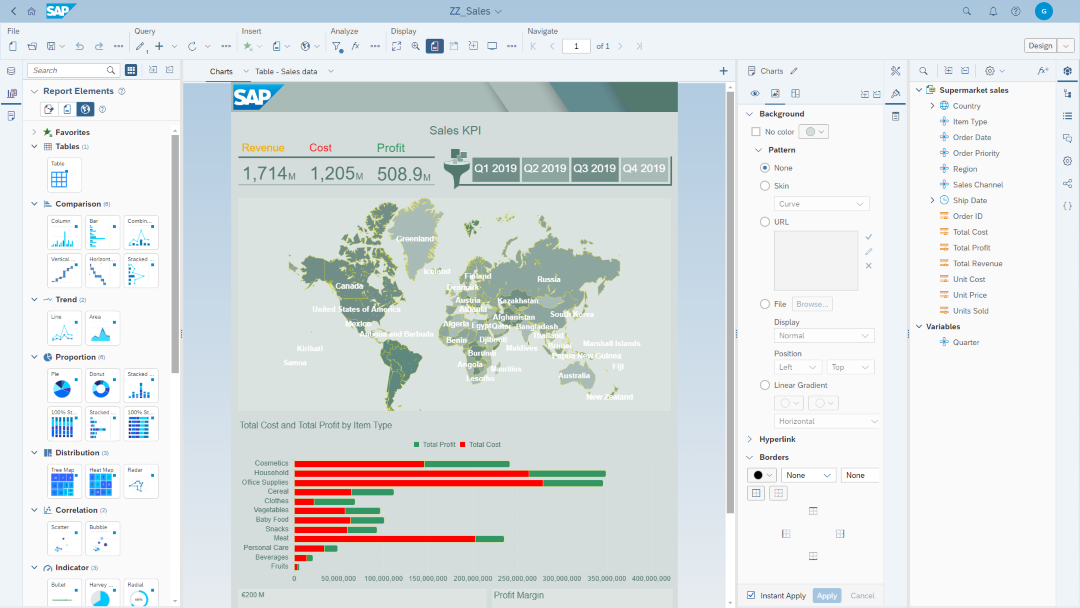
See Data Mode in SAP BI 4.3 SP4. Outdated systems would not add data cleansing features to their core product.
Beware of FUD
FUD, or fear, uncertainty, and doubt, is a common marketing strategy. But be wary of the sales pitches. And demand proof and case studies to support vague claims.
BusinessObjects is an “Outdated System”
False. With frequent product updates and patches, SAP continues to modernize BusinessObjects for new browsers, operating systems, databases, and cloud computing. Let’s be clear here, “outdated systems” are operated by organizations who terminated SAP support and are nursing along legacy BI 4.1 or BI 4.2 without the benefit of patches for security issues or even simple matters like browser compatibility.
But We Have a Modern Cloud Architecture…
Ironically, with the advent of cloud computing, any software provider’s architecture is a black box. It doesn’t matter whether the architecture is a containerized warp drive or patched together with hundreds of networked Raspberry PI – the capabilities provided outside the black box is what truly matters.
Rising Costs?
The claim that staying on “outdated software” leads to rising costs demands proof. Migrating content to other tools only for the satisfaction of unplugging BusinessObjects is not bringing value to the business. Do you know what really raises costs? Software vendors using their “poster boy” advantage to muscle through price increases. Do the math, as small prudent investments in your BusinessObjects platform can bring much-needed innovation to your organization without the much larger cost of acquiring and rolling out new software.
What Next?
Technology doesn’t exist for technology’s sake. It exists to improve the success of the organization. Nothing lasts forever, but organizations that depend on BusinessObjects can continue do so for the foreseeable future with confidence.
References
Tableau
In their latest release for 2024, Tableau boasts about Table Viz Extensions – tables for “legacy reporting” for “users who prefer traditional reporting views.”
Evolve from legacy reporting to visual analytics while meeting your users’ current needs. Tables are critical visualizations for analysts and help them inspect data as text and conveying details at lower grain. With Table Viz Extensions, you can add detail tables and grid views to dashboards for users who prefer traditional reporting views.
Microstrategy
5 Reasons to Modernize Your BI
MicroStrategy ONE vs. SAP BusinessObjects (BOBJ)
“SAP BusinessObjects (BOBJ) simply has not kept pace with modern analytics.”
Nope. In fact, I am making the opposite case in this article.
“BOBJ 4.3 is approaching end of life. Customers must adopt a new tool for enterprise reporting in the next 2 years.”
This is false. SAP is not requiring customers to find new enterprise reporting tools in the next two years.
“Outdated systems translate to security risks, rising costs, and missed opportunities for innovation.”
Let’s be clear here, “outdated systems” are operated by customers who terminated SAP support and are nursing along legacy BI 4.1 or BI 4.2. BI 4.3 is on patch support until
“Modern Containerized Cloud Architecture”
Breaking Free with MicroStrategy: How We Transformed Crate&Barrel’s Analytics
Any organization that has used BusinessObjects since 2003 will be able reduce the “number of reports from an overwhelming 35,000 to under 400.” Don’t blame the vendor for a lack of governance with your old tools. And by the way, your “legacy” tools are more likely to have a third-party ecosystem of governance options than your shiny new toy.
